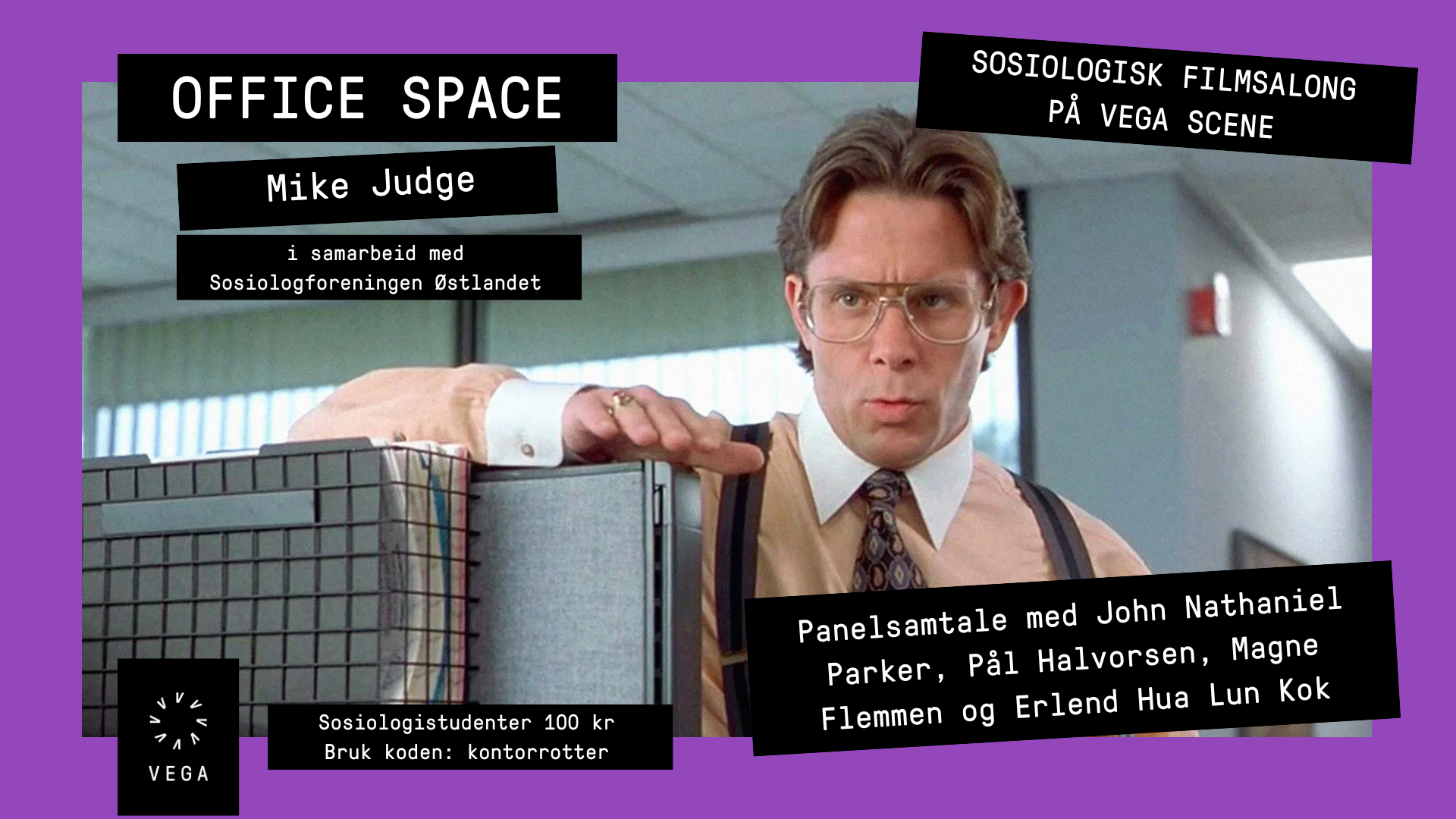
What makes «Office Space» sociologically relevant, and worth watching, 26 years later? We ask the same question Bjørnar Blaalid asked about «Requiem for a Dream» in his cultural commentary, only for the film «Kontorrotter», as it is called in Norwegian. The film deals with the disillusioned IT worker Peter Gibbons (Ron Livingston), his dissatisfaction and contempt for life as an office rat and what this life entails in terms of meetings, schedules, meaningless tasks, and not least eight different bosses who torment him. Despite Peter and his colleagues’ long-standing dissatisfaction, it is only when Peter goes to therapy with a hypnotherapist that things change: Peter’s feelings about his job change drastically, and with that the film exposes and ridicules the feeling rules of bureaucracy and modernity, and the ways in which they suck the meaning and magic out of life.
Enthusiasm and fun are required at the Chotchkie’s restaurant, where waitress Joanna (Jennifer Aniston) works. She must have at least fifteen «pieces » of flair», i.e. fun effects, which show how positive and lively she finds it to be to serve customers. The problem is that these fifteen effects are a minimum requirement. Joanna’s boss insists that she must show more commitment, even though it is clear that Joanna herself does not want it.
Arlie Hochschild’s concept of «feeling rules» also illuminates Joanna’s situation: feeling rules determine what one should feel in different situations and how to express those feelings (Hochschild, 1979). Rules for how to regulate feelings are what Hochschild calls the «underside» of ideology (p. 566): for example, can one express anger directed towards customers, the boss, or the company or not? By asking this type of question, one reveals how emotion rules underpin and reinforce particular ideologies.
That said, emotional rules, like other rules, can be bent, stretched, and broken, and that’s what the hero of the film, Peter, does. At the beginning of the film, Peter’s life is one of depression. He conforms to expectations of being polite and servile. However, when he goes to a hypnotherapist, Peter’s relationship with emotional rules and the authority they maintain is turned upside down. He ignores his boss’s order that he must work on Saturday and Sunday, and when he first shows up for work several days into the workweek, he rearranges his workstation by tearing down a wall so he can see the view. Then he plays Tetris. In this, Peter rejects the expected feeling rules of the office situation and gives into his more authentic self, achieving a level of freedom and happiness to which he could only dream of previously.
The transformation not only emphasizes how trapped Peter was as an individual by emotion rules, but also makes Office Space a wonderful starting point for sociological conversation. The drastic break with emotion rules reveals how emotion rules maintain structures, in this case a neoliberal corporation in the United States, and how these structures contribute to the commodification and alienation of individuals. In other words, Office Space reminds us of the presence of emotion rules outside the office landscape as well. To quote Hochschild in her case study of flight attendants at United Airlines: “In whose interest are these emotion rules? Some emotion regulation promotes the social good. Others [emotion regulation] do not. It is certain that the flight attendant’s belief that she “should feel cheerful” does more to promote revenue for United than to improve her own inner well-being” (Hochschild, 1979, p. 573).
Sosiologisk Filmsalong the October 21
More about emotional rules, rationality and irrationality, American humor and more about what the film means to us today will be served after the film screening at Vega Scene on October 21 at 6:15 PM. Select the ticket category «Sosiologforeningen» and use the code «kontorrotter» for a ticket for 100 kroner when you order here.
Reference:
Hochschild, A. R. (1979). Emotion Work, Feeling Rules, and Social Structure. American Journal of Sociology, 85(3), 551–575. https://doi.org/10.1086/227049